If I Don't Scribe It, I Feel I Lost the Meeting
Twenty years of notebooks taught me the discipline. AI has finally given that record a way to work for me. If a meeting matters enough to hold, it matters enough to keep.
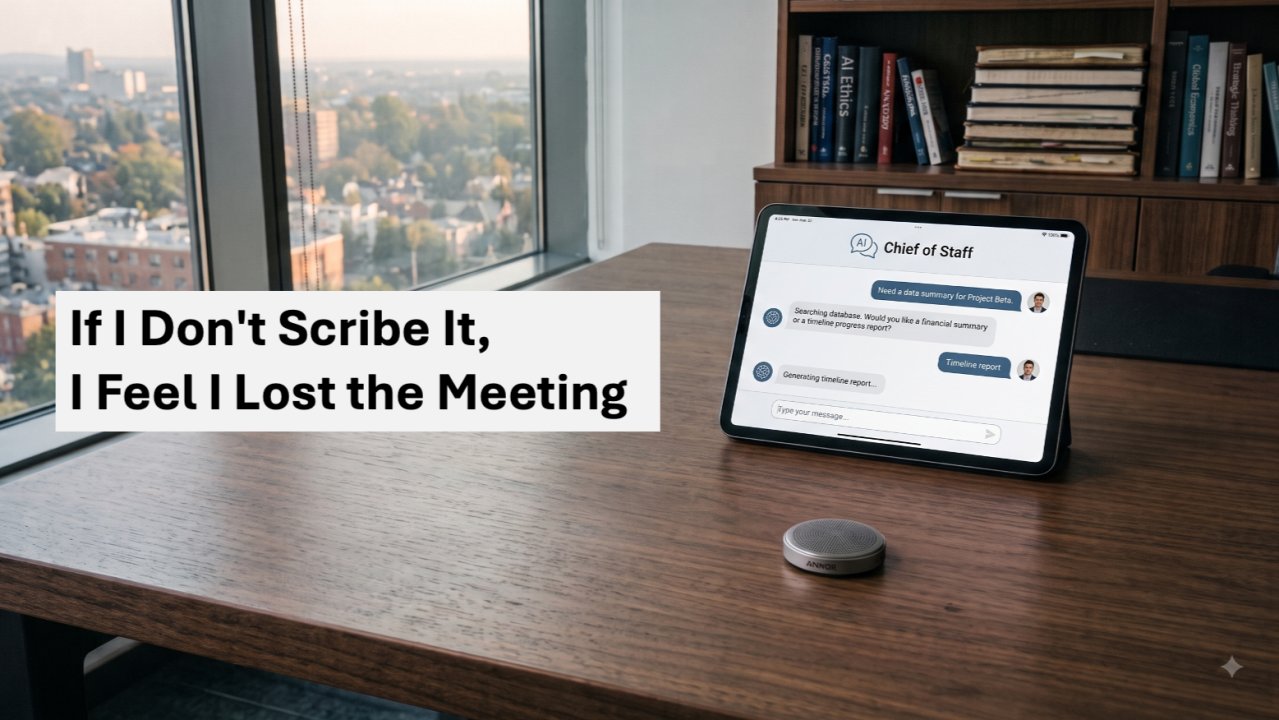
I have filled notebooks since the earliest days of my career. Somewhere there is a shelf holding twenty years of working life. But a notebook has one flaw: it cannot re-read itself, cannot connect page 40 of one to page 12 of another, and cannot remind me before a meeting that I have been here before.
The real problem is synthesis, not memory
A single day in hospital leadership brings a staffing gap on one ward, a readmission pattern that may connect to a discharge change made two months ago, a capital decision, and a corridor conversation with a physician that, if true, matters enormously. Multiply that by hundreds of days and dozens of workstreams.
The job is not remembering it all. The job is bringing it together: noticing that Tuesday's quality finding connects to a staffing discussion three weeks ago, which connects to Thursday's budget decision. Synthesis fails silently. Nobody sends an alert when two related facts sit in two separate meetings and never meet.
Medicine taught me the answer long before AI: if it isn't documented, it didn't happen. I have applied the discipline of the medical record to my own work, then given the record to a system that can work with it.
How I do it
A scribe for scheduled meetings. An AI note-taker produces clean transcripts and notes. The scribe holds the record; I hold the room.
A small recorder for everything else. The most consequential conversations happen on ward rounds, in corridors and after the official meeting ends. I capture these too, always with the other person's knowledge.
Everything flows into my AI assistant's context. A transcript in a folder is an archive. A transcript in an assistant's working memory is context. Questions no human assistant could answer become routine: which themes keep recurring that we have not formally addressed, which commitments I am carrying into this week, what a group raised last time and what we promised.
The obligations
Consent comes first: people know when a discussion is recorded, and sensitive conversations stay off the record. Confidential material is governed with the same instincts as a patient record. And the assistant informs my judgment; it does not replace it.
What changed
- I listen better. When I am not trying to capture everything, I am present for everything.
- Follow-through stopped slipping. Forgetting became harder than remembering.
- The assistant became genuinely useful. The difference is not the model. It is the context you feed it.
In Connected Care I called healthcare's failure mode "infobesity": data that piles up without nourishing judgment. Executive life has the same disease and the same cure: continuity, context and a record that serves decisions instead of burying them.
Questions for boards and leadership teams
- How many decisions in our last quarter were made without the record of what was said before?
- Do we have a clear consent and confidentiality policy for recording meetings?
- Which of our executive commitments are tracked anywhere other than in individual memories?
- Are we giving our AI tools the context they need, or judging them on empty prompts?
The discipline came first. The technology only recently caught up to it.
First published in The Chief Healthcare Officer newsletter on LinkedIn.
Related reading: The EMR is a management tool · The daily huddle
Dr Fatih Mehmet Gul is a physician and healthcare executive who has built, commissioned and led hospitals across the Gulf and Türkiye. He is an Honorary Professor at UCL Global Business School for Health, author of Connected Care, and host of The Chief Healthcare Officer podcast.
More insights →