Will AI Replace Hospital Employees? Lessons from Teaching Leaders at UCL
AI will not replace hospital employees. It will replace outdated thinking about what healthcare leadership means. The real question is how we put the human being at the centre of every AI decision.
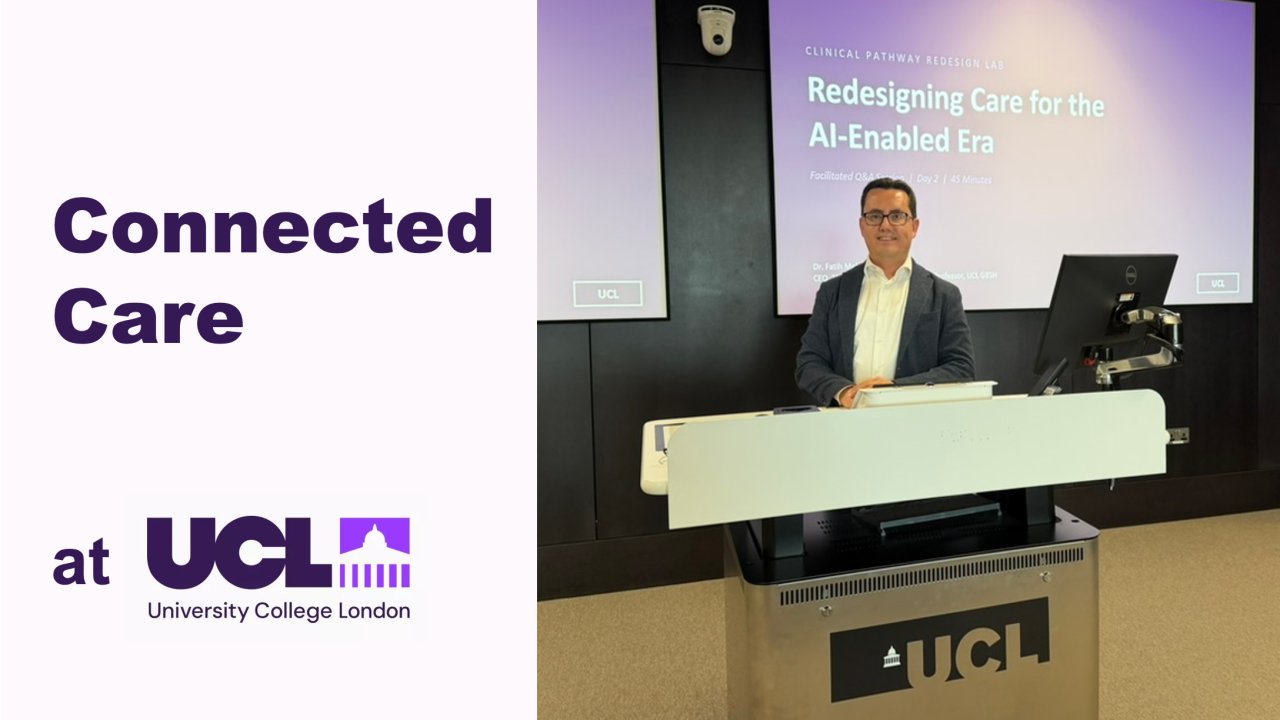
With Professor Nora Colton, I co-led the Leading Healthcare in the Age of AI bootcamp at UCL Global Business School for Health. The room was full of C-suite executives, system directors and clinical leaders, and one question kept them awake at night: will artificial intelligence replace my hospital employees? I came to teach. I left having learned a great deal from the leaders in the room.
AI replaces administrative burden, not caregivers
The fear was real. If we deploy AI scribes, will we need fewer doctors? If we use AI triage, fewer nurses? The better framing is a division of labour. AI handles the noise: documentation, scheduling, billing logic, routine follow-up. People handle the care: clinical judgment, empathy and complex decisions. The time released returns to the bedside. In my experience, organisations that use AI to remove administrative work see better staff retention, because caregivers get back to the work they entered medicine to do.
Governance must come before implementation
Almost every leader was planning to deploy AI. Very few had a governance framework. Before choosing any AI solution, a leadership team should be able to answer:
- Who is responsible if the system fails or causes harm?
- What data trained the model, and who is missing from it?
- How will we audit for bias, continuously rather than once?
- What is the escalation path when the AI recommends something clinically questionable?
- Do patients know AI is involved, and can they opt out?
These are not IT questions. They are leadership questions, and they must be answered before a contract is signed.
Augmentation is the differentiator
The participants who grasped the opportunity were not asking how to automate faster. They asked how a tool would give their clinicians more time with patients. Every solution we discussed passed through four tests: does it reduce administrative friction, give caregivers more presence, strengthen the patient–caregiver relationship, and improve outcomes for the communities we serve? If not, it is not Connected Care. It is just technology.
Equity and transparency are non-negotiable
One participant described an algorithm trained mostly on affluent patients that systematically underestimated risk in lower-income patients. Statistically accurate; inequitable by design. Healthcare AI must be trained on representative data, audited independently and continuously, and designed with the communities it serves. This is not an abstract ethics position. It is an operational responsibility.
Questions for boards and leadership teams
- Do we have an AI governance framework approved before, not after, our first deployment?
- For each AI tool, how many hours have we returned to clinical care, and can we show it?
- Who in our population is under-represented in the data our AI vendors used?
- Do our patients know when AI supports their care?
Technology without humanity is just automation. Technology with humanity is transformation.
First published in The Chief Healthcare Officer newsletter on LinkedIn.
Related reading: AI in hospitals: policy before pilot · Why accurate AI fails in hospitals
Dr Fatih Mehmet Gul is a physician and healthcare executive who has built, commissioned and led hospitals across the Gulf and Türkiye. He is an Honorary Professor at UCL Global Business School for Health, author of Connected Care, and host of The Chief Healthcare Officer podcast.
More insights →