The Healthcare Leader in the Eye of the Technology Storm
New solutions arrive weekly. Young staff push forward, senior staff push back, patients want digital and boards want a return. And you still have a hospital to run. The storm will not calm down; what can change is your relationship to it.
Being a healthcare leader today is one of the most disorienting positions in any industry. A new AI platform this quarter, a new interoperability requirement next. Nurses fluent in tools you have never touched. Senior consultants resisting everything new. Patients who asked a chatbot about their symptoms before they arrived. A board that wants a digital strategy at the next meeting.
Four forces pulling in four directions
- Tech-savvy staff push for digital-first workflows. Their energy is an asset, but without direction it fragments.
- The resistant majority of experienced clinicians protect what works. Their resistance is self-preservation, not stubbornness. They need a reason, not a mandate.
- Patients who bank, shop and communicate digitally expect the same from healthcare.
- Boards and shareholders want measurable returns before the culture has been built to produce them.
Why most digital transformations fail
The pattern repeats on every continent: thorough procurement, impressive demo, announced go-live, and six months later half the staff still use paper. This is a change management failure, not a technology failure. Tools are introduced without explaining the benefit to the person using them. Platforms are deployed in isolation, creating data islands: digital accumulation, not transformation. Leaders do not visibly use the technology. Training stops at go-live. And data is collected but never turned into decisions.
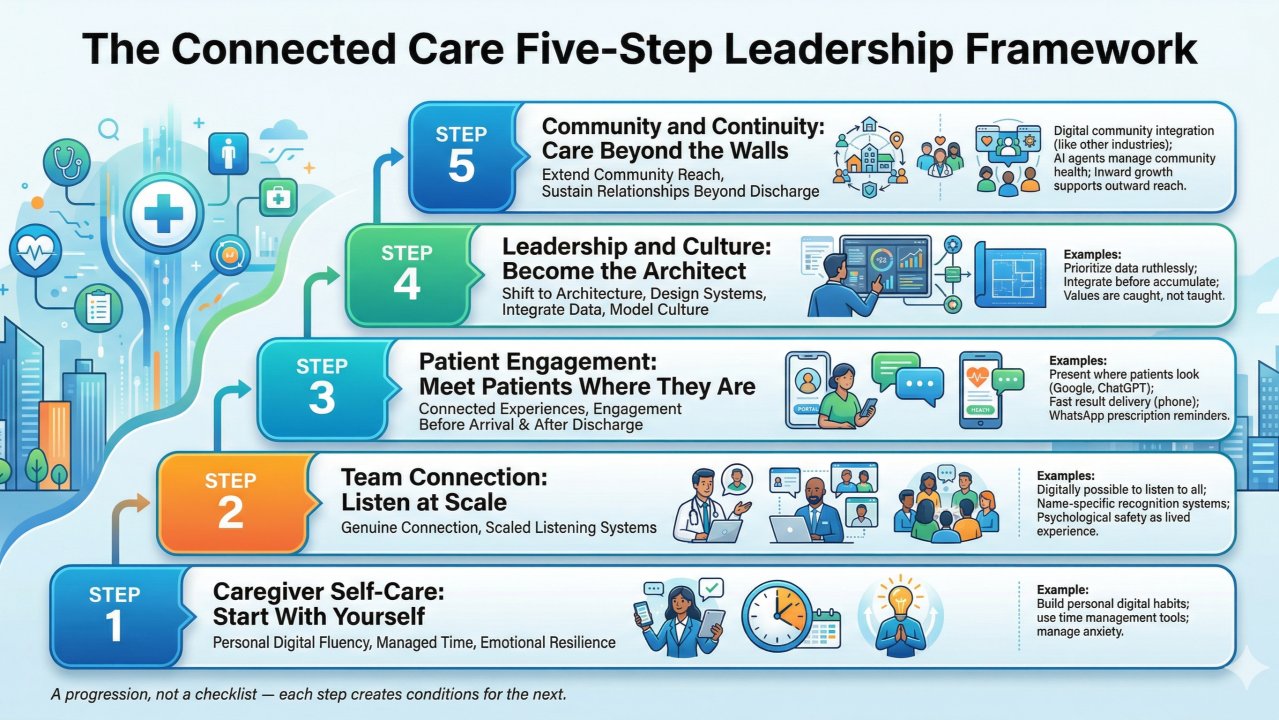
A five-step Connected Care framework
1. Start with yourself. Build your own digital fluency, manage your time and protect your resilience. A leader anxious about technology broadcasts that anxiety to the whole organisation.
2. Listen at scale. You cannot personally know 5,000 people, but you can digitally hear all of them. Recognise staff by name when patients praise them. Psychological safety is not a policy; it is the lived experience of everyone who considers speaking up.
3. Meet patients where they are. Most patients search online before they see a doctor. Results on a phone in two hours instead of a return visit tomorrow is a gap patients feel every day. A WhatsApp medication reminder can be the difference between healing and not.
4. Become the architect. Prioritise data ruthlessly: a data-drunk organisation is as dangerous as a data-absent one. Integrate before you accumulate. Values are caught, not taught.
5. Care beyond the walls. Extend the relationship into the community so care does not end at discharge. AI will soon help manage the health of whole communities; the preparation starts now.
Handling the push and pull
Resistance is information. A senior clinician resisting the EMR is usually protecting something real: patient safety, professional identity or time. Make it about them. For doctors, the record means the previous history in seconds. For nurses, digital supply management means safer, simpler shifts. For patients, results on the phone means no lost half-day. One hospital created a "patient technology technician" whose only job was to translate between engineers and clinicians, and adoption rose at every level. People are never against you; they are for themselves.
Three actions for this week
- Audit your own digital habits. Your team is watching which tools you use.
- Map how often each stakeholder group hears from you, and through which channel.
- Integrate two systems that do not talk to each other, instead of buying a new one.
Questions for boards and leadership teams
- Which of our digital investments has full adoption six months after go-live?
- How many disconnected platforms do we run, and which two should we integrate first?
- Do our senior leaders visibly use the tools we ask staff to adopt?
- Does training continue after go-live?
Digital tools are not the goal of Connected Care. Connection is the goal.
First published in the Connected.Care newsletter on LinkedIn. The full framework is set out in my book, Connected Care.
Related reading: People first, technology next · Healthcare in 2050: connected, or just digital?
Dr Fatih Mehmet Gul is a physician and healthcare executive who has built, commissioned and led hospitals across the Gulf and Türkiye. He is an Honorary Professor at UCL Global Business School for Health, author of Connected Care, and host of The Chief Healthcare Officer podcast.
More insights →