Your Title Is Not Your Leadership
Every organisation has outcomes nobody chose. If you lead the system, those outcomes are still your decisions, including the ones you never consciously made.
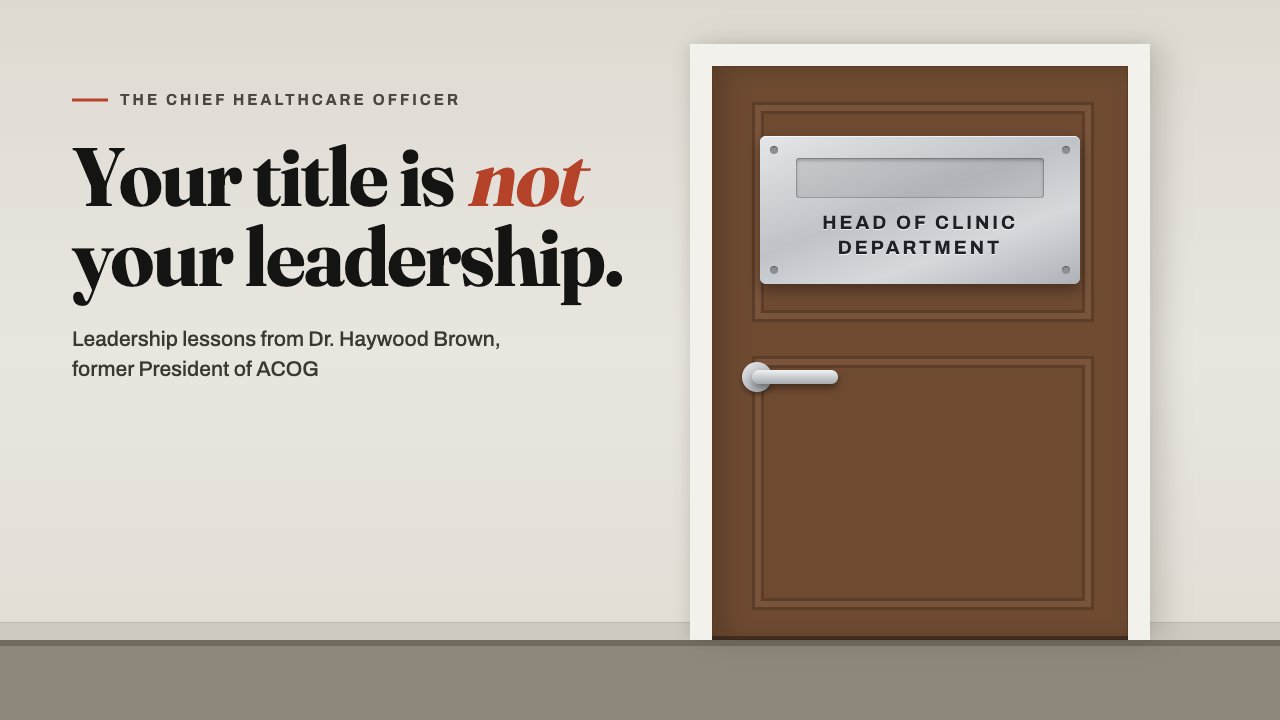
Nobody votes for the patient who falls through the gap between two departments. No board minute records the moment an inequity became acceptable. And yet it happens every day, in hospitals run by intelligent, well-meaning people.
I explored this with Dr Haywood Brown on The Chief Healthcare Officer podcast. He chaired Obstetrics and Gynecology at Duke for 14 years, served as President of the American College of Obstetricians and Gynecologists, and now works in prenatal diagnostics at BillionToOne. What he told me should unsettle anyone with a title.
1. Equity is not a value. It is a decision.
Most organisations write equity into the mission statement and then treat unequal outcomes as bad luck or patient behaviour. Dr Brown rejects that. When women arrive for pregnancy care too late, that is not a patient failure. It is how access was designed, and access design belongs to leaders. If the outcome is predictable and the design has not changed, a choice has been made.
2. Find where your responsibility quietly ends
Most maternity systems still treat postpartum care as a single appointment at around six weeks. The risks do not follow that timeline. Dr Brown sees the "fourth trimester" as the start of a woman's long-term health, not the end of a pregnancy episode. Every organisation has a point where it decides "this is no longer our problem". Almost none decided it deliberately.
3. Know what you are actually measuring
In maternity care there is always a patient and a passenger. A healthy baby is not the finish line; a healthy mother is. Look at your dashboard. What gets measured gets led. What is not measured is quietly abandoned.
4. The best lessons do not come from the boardroom
Some of Dr Brown's most important lessons came from students, residents, nursing assistants and commercial teams, not fellow chiefs. If everything you know about the organisation arrives through your direct reports, you are leading a version of it that does not exist.
5. Go first
Keep learning, listen properly, let people test their ideas, and show through your own actions that no task is beneath the person at the top. Not a framework. A standard, held consistently, especially when nobody is watching.
Questions for boards and leadership teams
- Which outcome in our organisation have we accepted without ever deciding to?
- Where does our responsibility for a patient end, and who decided that?
- Does our dashboard measure the outcomes that matter, or only the ones that are easy to count?
- When did each of us last learn something important from someone outside the executive team?
Which outcome in my organisation have I accepted without ever deciding to?
Listen to the full episode at chiefhealthcareofficer.com.
First published in The Chief Healthcare Officer newsletter on LinkedIn.
Related reading: Execution in healthcare · A culture of recognition saves lives
Dr Fatih Mehmet Gul is a physician and healthcare executive who has built, commissioned and led hospitals across the Gulf and Türkiye. He is an Honorary Professor at UCL Global Business School for Health, author of Connected Care, and host of The Chief Healthcare Officer podcast.
More insights →