Every Job in Healthcare Will Change
AI will not leave any healthcare role untouched. The question for every clinician and manager is not whether their job will change, but whether they will shape that change.

The business advisor Ram Charan put it bluntly in a recent discussion on the future of work: everyone's job will change, and the only sensible response is to confront that reality. He was speaking to business in general, but I hear it as a direct message to healthcare.
Whether you are a chief medical officer, a pharmacist or a nurse on a busy ward, your role is not simply evolving. Parts of it are being rewritten. My own view, after more than 25 years in hospitals, is that the professionals who learn how their job will change will lead the next decade. Those who wait will find the change made for them.
Physicians: from walking encyclopaedia to clinical orchestrator
For a century a physician's value rested heavily on memory: knowing the literature, recognising the rare pattern. AI is now very good at synthesising large volumes of literature and patient history. That does not make the doctor less important. It moves the doctor's value to judgement, ethics, difficult conversations and leading an AI-supported care team. Confidence will come less from having every answer memorised and more from knowing how to ask, check and decide.
Nurses: less paperwork, more clinical intelligence
Nursing has carried too much repetitive documentation for too long. Automated observations, early-warning tools and ambient documentation can take much of that weight away. When a system flags deterioration hours earlier, the nurse becomes the person who acts early, not the person who writes it down afterwards. That is a shift from task completion to clinical oversight.
Pharmacists: beyond the dispensing counter
Robotic and automated dispensing is already the standard for accuracy and speed in many hospitals. The pharmacist's future is in medication safety, stewardship, complex polypharmacy and, increasingly, personalised therapy. The role moves from dispensing to advising.
Technicians: guardians of the data
In radiology and the laboratory, AI can screen large numbers of images and slides and highlight what needs a closer look. The technician's value moves from capturing the image to making sure the whole chain is right: quality of acquisition, calibration and noticing when the machine's output does not make sense.
Hospital operations: the air traffic control model
Bed management, staffing and patient flow are becoming predictive. Good command centres already forecast surges and staffing gaps days in advance. Managers who used to fight fires will increasingly oversee a system that warns them before the fire starts. That needs a different skill set: reading data, trusting it appropriately and acting early.
The hospital beyond the building
The biggest change may be to the hospital itself. Through wearables, remote monitoring and digital follow-up, the hospital is becoming a community hub that stays in touch with people between visits, rather than a building they enter only when something has gone wrong. This is the heart of Connected Care: continuity between encounters, with the human relationship at the centre.
How to prepare
- Learn the tools in your own field. Do not just use them; understand what they do well and where they fail.
- Invest in the human skills. Empathy, communication and ethical judgement are the parts of the job AI cannot do.
- Be willing to step sideways. A course, a secondment or a role in a digitally advanced service may be the fastest way forward.
- Let AI take the volume so you can focus on quality. The aim is not more work in less time. It is better work.
Questions for boards and leadership teams
- Have we mapped, role by role, which tasks AI will take over in the next three years?
- Do we have a reskilling plan, or are we hoping people will adapt on their own?
- Are clinicians involved in choosing the tools that will change their work?
- How will we measure whether AI is improving the quality of work, not only its speed?
Learn how your job will change, or the change will be made for you.
You can watch Ram Charan's discussion on AI and the future of work on YouTube.
First published on LinkedIn.
Continue reading
- Will AI Replace Hospital Employees? Lessons from Teaching Leaders at UCL. AI will not replace hospital employees.
- The Healthcare Leader in the Eye of the Technology Storm. New solutions arrive weekly.
- Your Title Is Not Your Leadership. Every organisation has outcomes nobody chose.
Topics: #AIinHealthcare · #HealthcareWorkforce · #HospitalLeadership
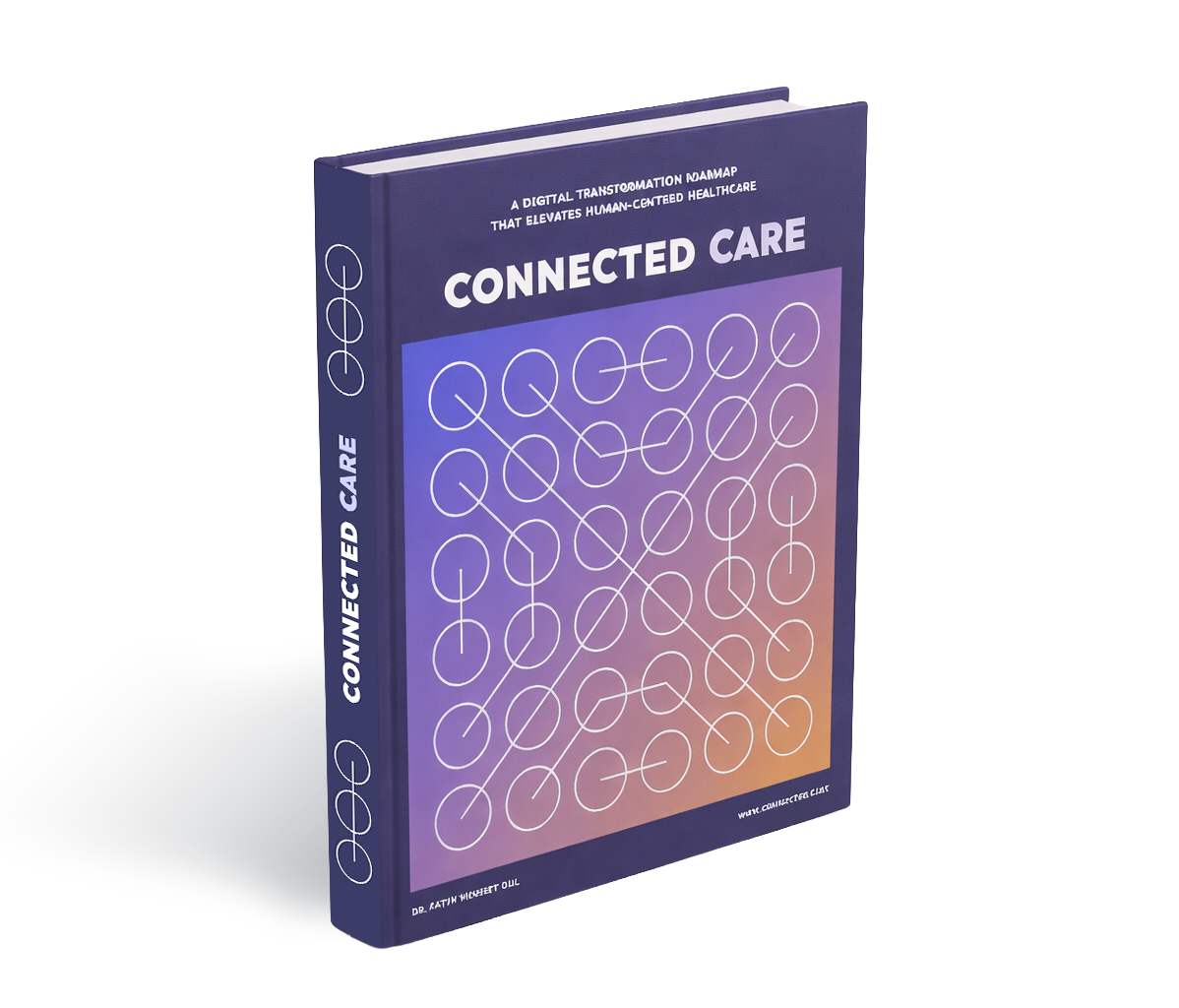
Enjoyed this article? There is more in Connected Care.
Many of the ideas here began in my book on healthcare leadership and digital transformation.
Dr Fatih Mehmet Gul is a physician and healthcare executive who has built, commissioned and led hospitals across the Gulf and Türkiye. He is an Honorary Professor at UCL Global Business School for Health, author of Connected Care, and host of The Chief Healthcare Officer podcast.
More insights →